February 23–25, 2023 Le Locle & La Chaux-de-Fonds, Switzerland — 47.0999° N, 6.7928° E EDAR Course AR-669

Index / PhD Notes / PHD–01

Beatrice Vaienti

Between Spatial Practices and Governance

PHD–01 EPFL Field Notes — Feb 2023

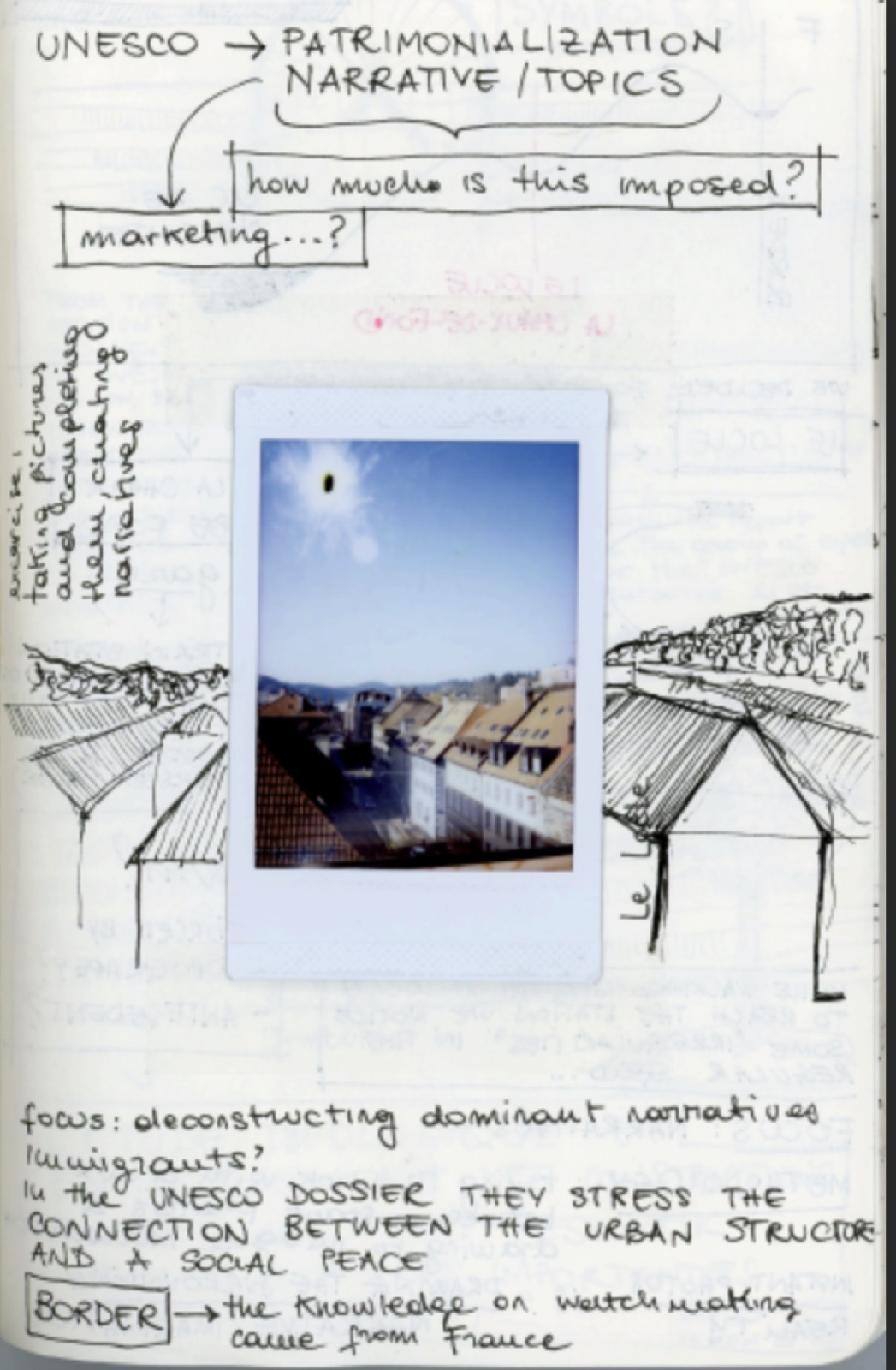
The inscription of Le Locle and La Chaux-de-Fonds on the UNESCO World Heritage List has brought international recognition to the cities, but it also may raise questions about the impact of dominant narratives on its urban space [Bordone 2021, 220–221]. That is, can the focus brought by the inscription on the watchmaking industry lead to overlooking other important aspects of the cities’ history? Is the process of creating a linear thematic narrative for a site affecting the collective memory of the inhabitants about the place?

The patrimonialization process, also suggested by the use of the term “property” for the inscribed sites, leads to the creation of “new, universal layers of meaning” [Smith 2006, 101].

Field notes by Beatrice Vaienti, plate 1
Plate 01 — field notebook, Beatrice Vaienti
§ 02

Methodological approach: group work

Moreover, the linear and non-conflictual nature of this thematic approach risks to oversimplify the complexity of a place and its history, resulting in a narrow perspective that may exclude important aspects of its heritage. This topic has inspired my fieldwork, which tried to delve into the thematic approach employed for UNESCO candidatures and its effects on heritage and memory, along with the contrast between dominant and hidden narratives.

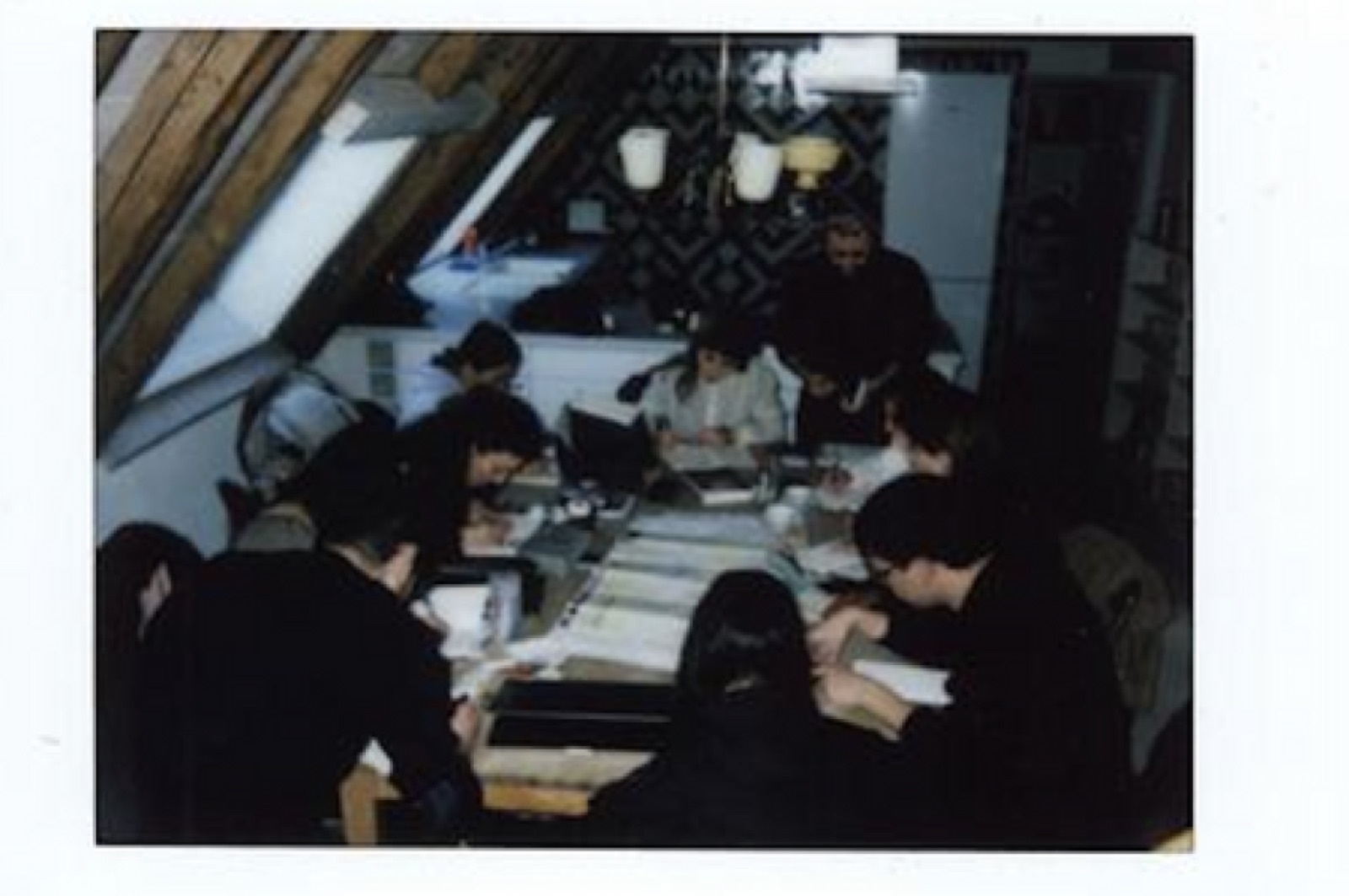
Following a brainstorming session to identify the elements we wished to explore and to understand each other’s background, we opted to start our journey in La Chaux-de-Fond.

As a group, given our common interests, we decided to focus on the processes of heritage patrimonialization and the deconstruction of dominant narratives.

On the one hand, we sought to identify any signs of these processes and elements that could attest the relationship between the organized urban structure and the watchmaking industry.

On the other, we aimed to uncover any historical aspects of these towns that may have been concealed by the process of brandization: dissonant elements or peculiar objects without evident explanations. In other words, we were interested in identifying any counter-narratives that may emerge beyond the non-conflictual historical narrative of the place.

Here, we employed the municipality's tourist guide as an initial framework for our tour. The latter part of our day was instead reserved for our visit to Le Locle. While the tourist guide provided us with a general itinerary, we intentionally avoided a rigid schedule.

We aimed to meander through the streets, adopting a sort of flâneur 's approach and allowing ourselves the freedom to deviate from our planned route.
Field notes by Beatrice Vaienti, section 02, plate 1
§ 02 · Plate 01 — Beatrice Vaienti
§ 03

Methodological approach: the notebook

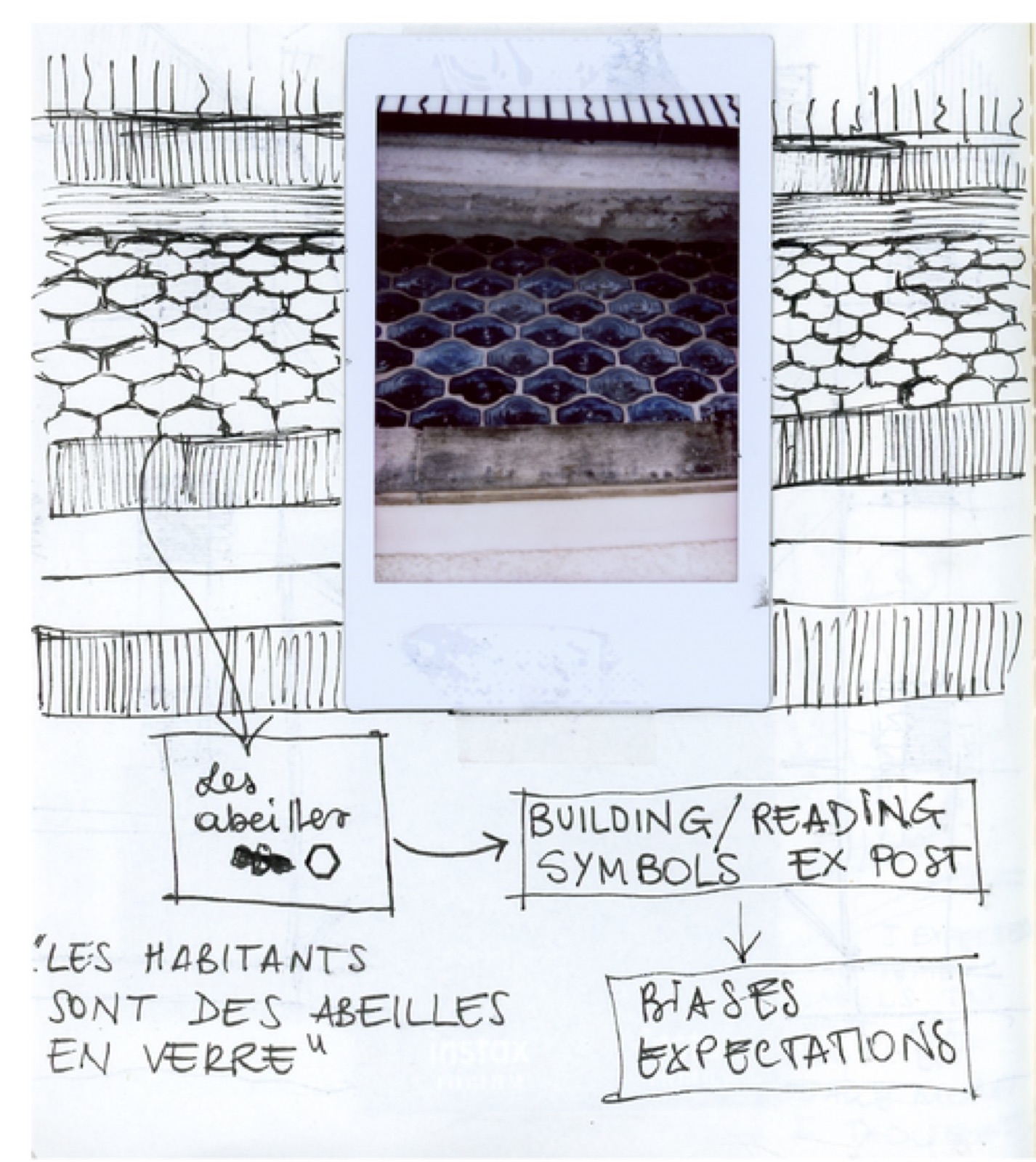
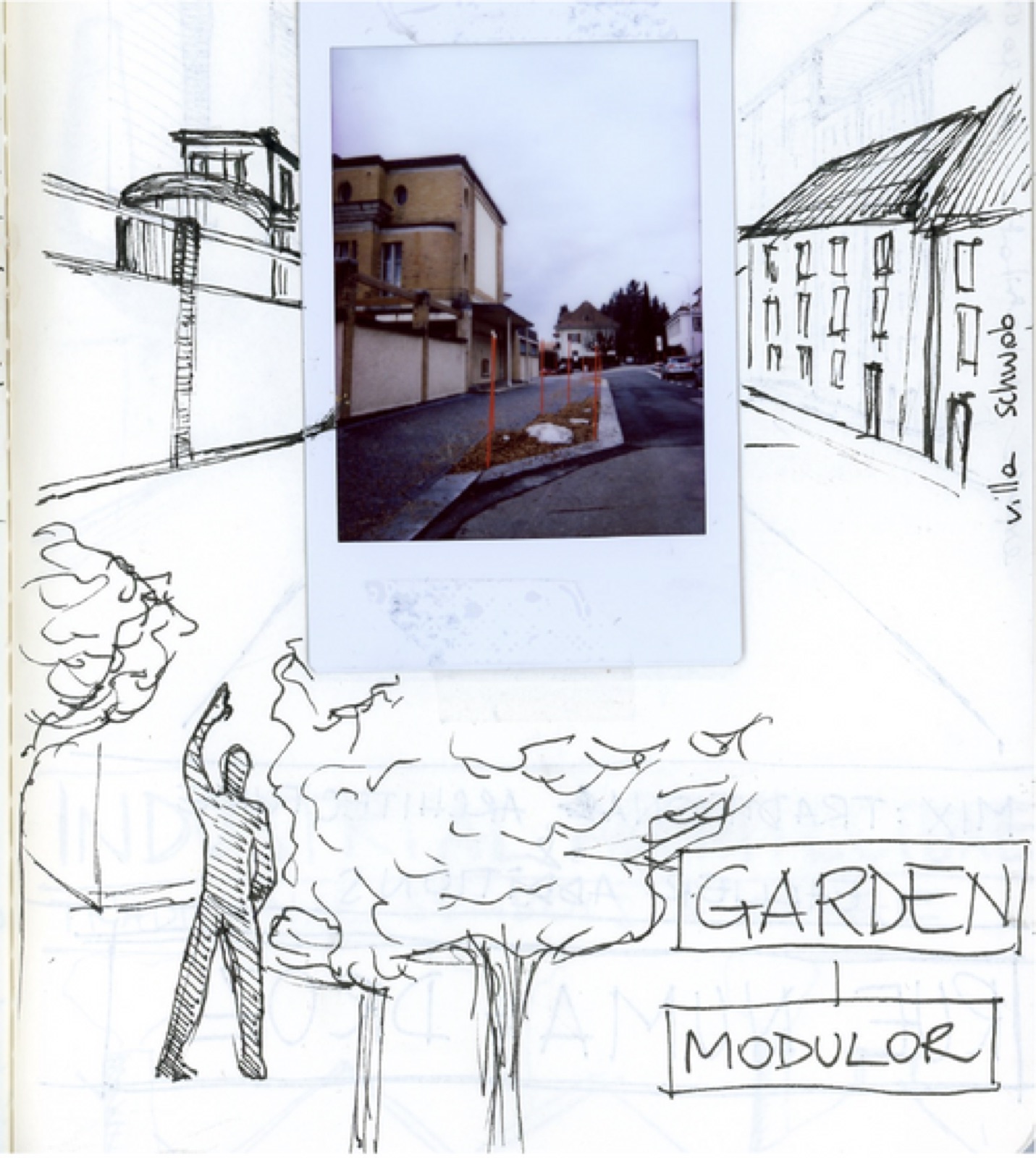
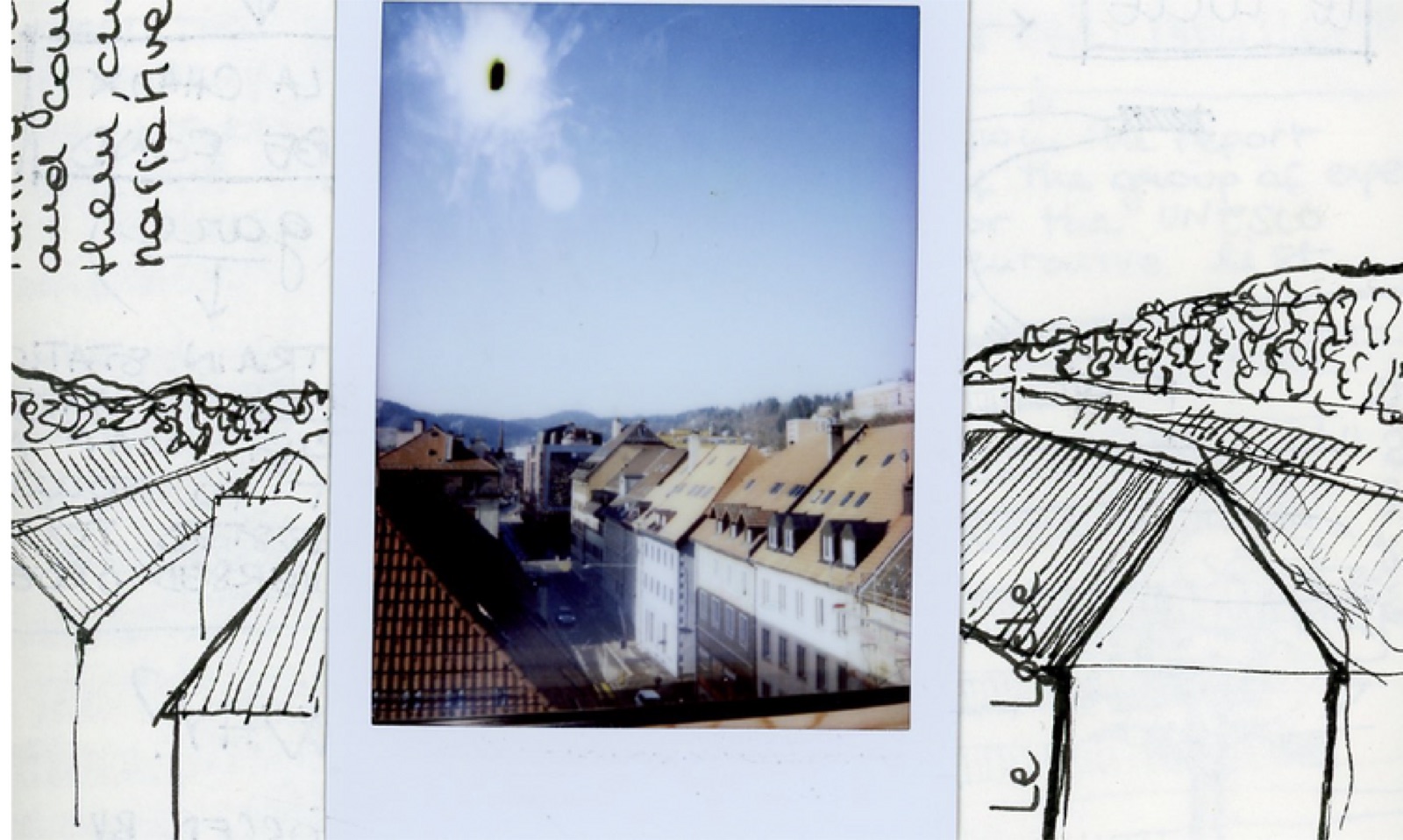
As for the methodology for recording my observations in the notebook, I decided to use a combination of polaroids , drawings , and text .

The instant photo was meant to capture a specific element, whose representation was objective but still dictated by my gaze.

The drawing surrounding the picture, and completing it outside its bounds, was plausible, but not necessarily accurate.

It was meant to record an imagined reality, often created while being in another location. The text represented an even successive layer of information, added mainly after the seminar to record my reflections and additional information and to note any keywords suggested by the recorded element.

Field notes by Beatrice Vaienti, section 03, plate 1
§ 03 · Plate 01 — Beatrice Vaienti
Field notes by Beatrice Vaienti, section 03, plate 2
§ 03 · Plate 02 — Beatrice Vaienti
§ 04

The intent in this use of multiple media was to try to capture different levels of biases and expectations in narratives recording, while questioning the objectivity of my gaze even in a seemingly objective mean such as photography.

It also provided a way to record different layers of reality, ranging from the objective to the subjective.

Additionally, the text component, added after the seminar, allowed me to embed additional information on the elements that were originally photographed out of curiosity, but without knowing much about them.

This helped me to reflect further on the fieldwork with a more rational and inquisitive perspective, while adding anecdotes and historical details on the captured objects.

§ 05

Travelogues, Narratives, and Biases: Exploring Memory Collection Methodologies

The notebook that was produced through this seminar assumed in the end a form very similar to that of a travelogue. The multilayered nature of it appeared to be interesting as a methodology to reflect and re-elaborate the material collected, other than just record it.

Moreover, no matter how objective the medium used may have been, our personal gaze and expectations seemed to be the primary elements captured by this approach, which made in my opinion this methodology even more interesting.

Field notes by Beatrice Vaienti, section 05, plate 1
§ 05 · Plate 01 — Beatrice Vaienti
Field notes by Beatrice Vaienti, section 05, plate 2
§ 05 · Plate 02 — Beatrice Vaienti
§ 06

Since in my research I’m dealing with citizen science techniques for the collection of historical memories, this multiplicity of narratives and perspectives represented a key area of interest for me.

Moreover, since my case study also deals with the presence of conflicting narratives, I decided to focus on the research axis about dominant narratives and their deconstruction.

Specifically, I wanted to explore the impact of these narratives on urban spaces, especially in relation to UNESCO listing.

This interest was fuelled by the debates surrounding the inscription of Jerusalem’s Old City on the UNESCO list, which mainly revolve around the effectiveness of UNESCO's actions in preserving sites within conflictual contexts.

For these reasons I aimed to focus on elements that fell outside of these dominant narratives. However, this methodological choice raised important questions regarding the extent to which our preparation before going on-site influenced our perceptions and expectations. how much was our gaze affected by it?

Did this lead to potentially overlooking or disregarding some elements that may have been important to record?

§ 07

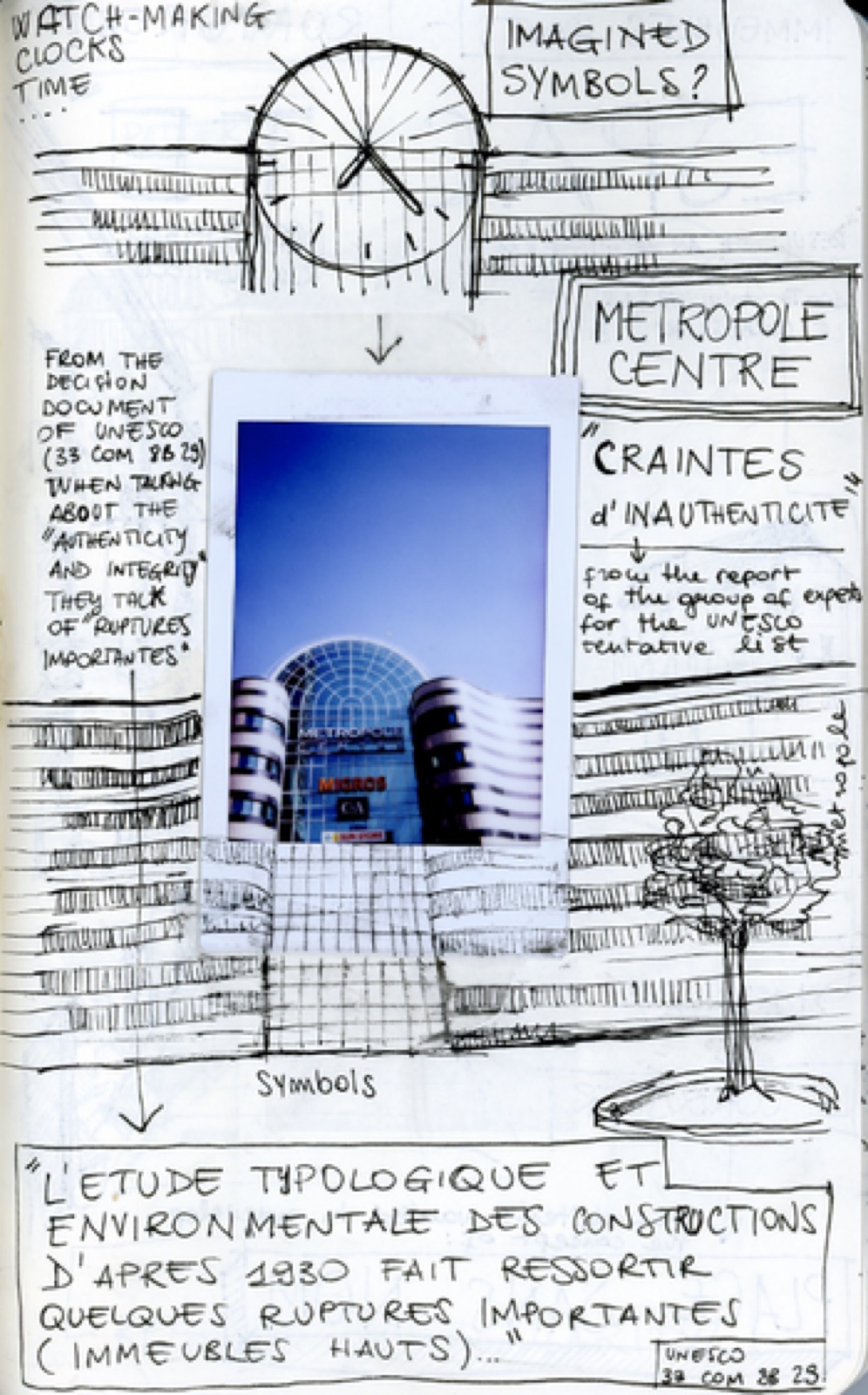
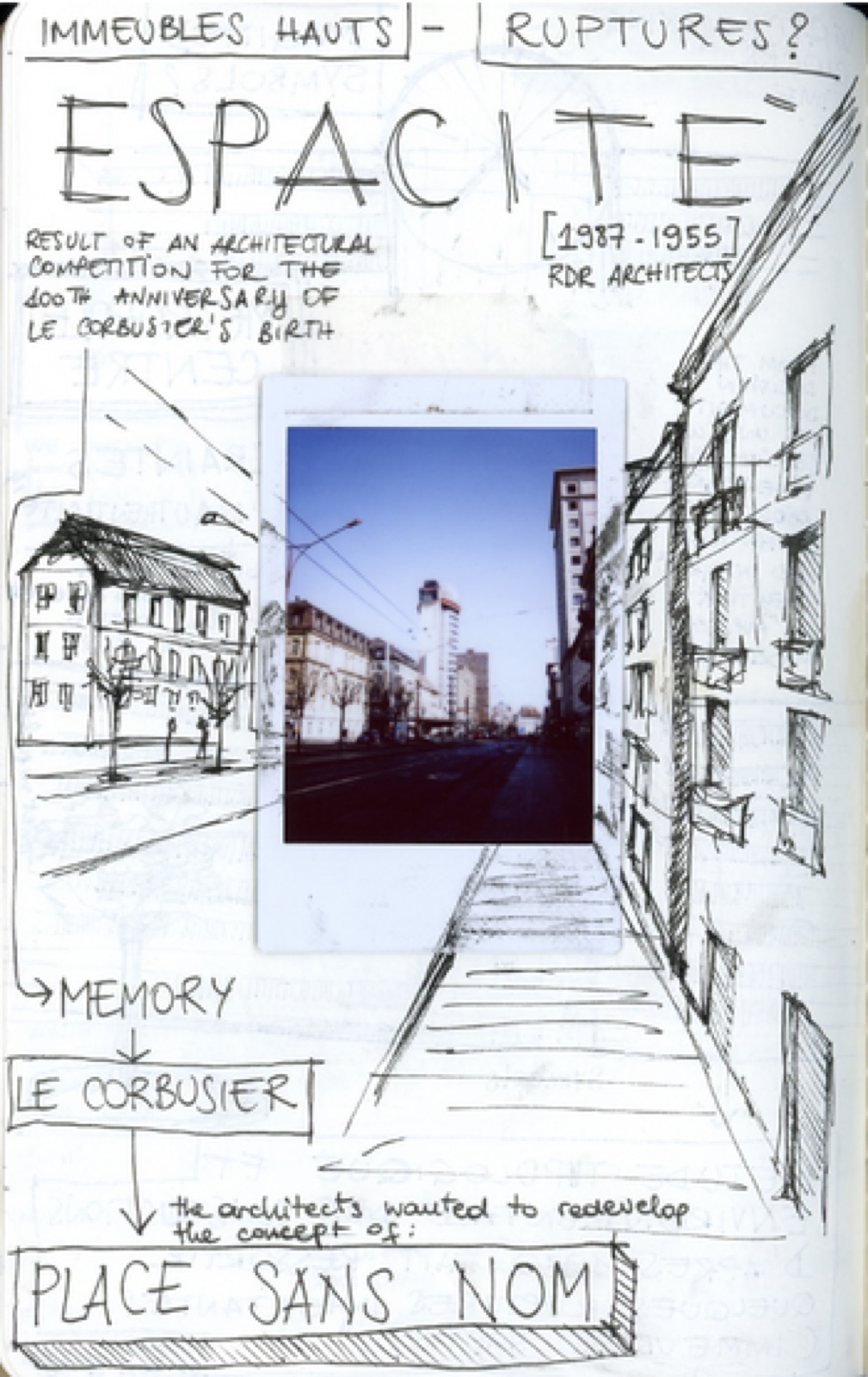
Following this line, the initial thematic focus of the fieldwork was on denied heritage. In the UNESCO decision report we can read that “L'étude typologique et environnementale des constructions d'après 1930 fait ressortir quelques ruptures importantes (immeubles hauts)” . While the nomination file speaks of “accidents morphologiques” . In particular, the Centre Métropole and the Espacité were addressed during the inscription process as two elements of rupture, as “ craintes d’inauthenticité” .

It was then interesting to learn that the Espacité was meant to celebrate the heritage of Le Corbusier and was developed after a competition for ideas launched by the municipality.

The rejection of the UNESCO proposition "L’oeuvre architecturale et urbaine de Le Corbusier" in the same year, and its subsequent acceptance in 2016 with the

Field notes by Beatrice Vaienti, section 07, plate 1
§ 07 · Plate 01 — Beatrice Vaienti
Field notes by Beatrice Vaienti, section 07, plate 2
§ 07 · Plate 02 — Beatrice Vaienti
§ 08

exclusion of the buildings in the Jura, raises the question of how much this influenced the way in which this part of heritage was displayed in the city.

During the fieldwork, a second focus was to capture elements that caught my curiosity, approaching my observations with a more open perspective.

This, for me proved to be an interesting way of discovering less displayed stories.

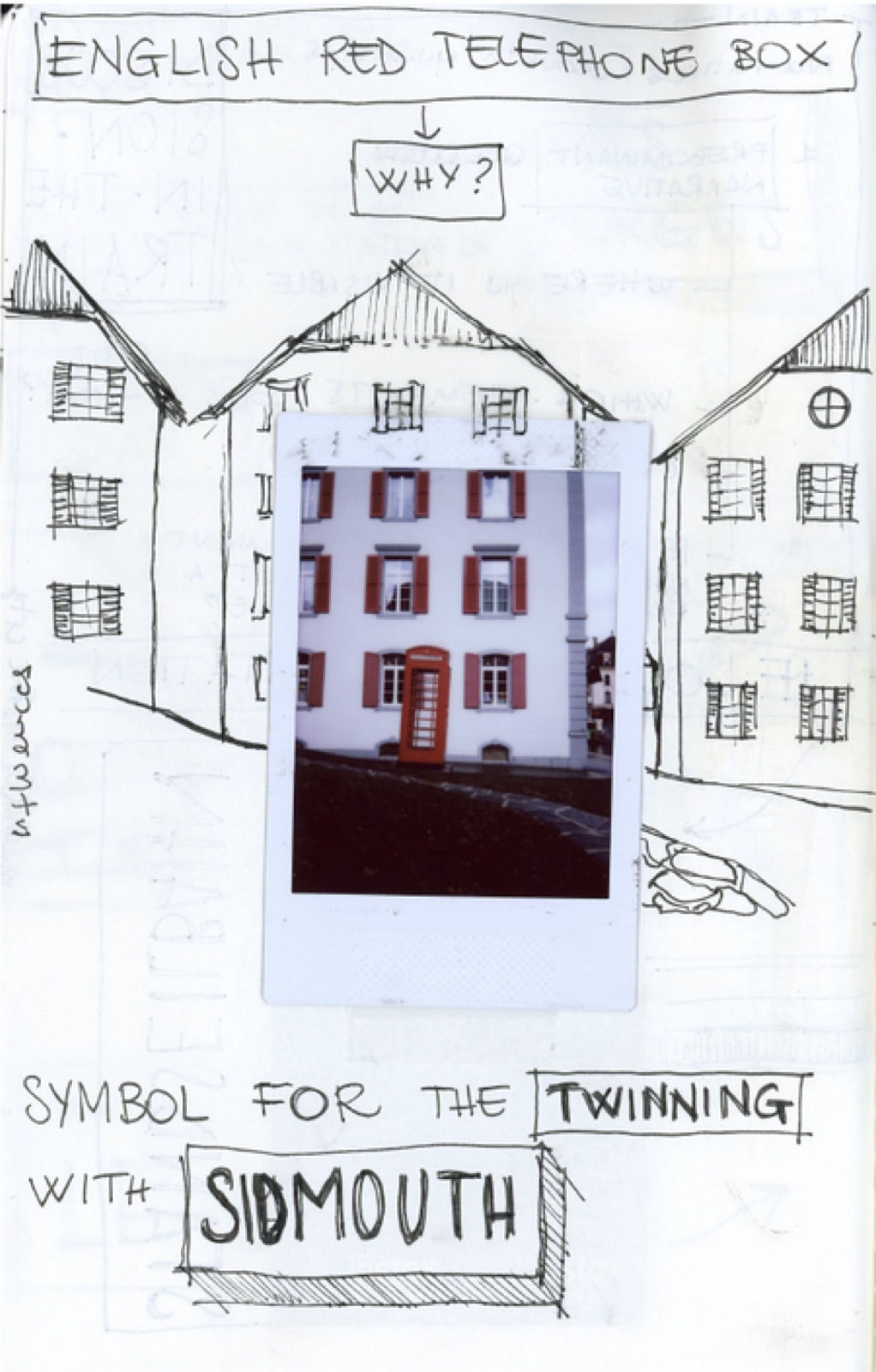
For instance, after some online research, the red telephone box in Le Locle was found to be a sign of the twinning of the city with the English city of Sidmouth.

The fountain of la Chaux-de-Fonds was created to commemorate the moment when water was first brought to the town, while the year “1848” carved in Le Locle was meant to remember the Neuchâtel revolution.

Field notes by Beatrice Vaienti, section 08, plate 1
§ 08 · Plate 01 — Beatrice Vaienti