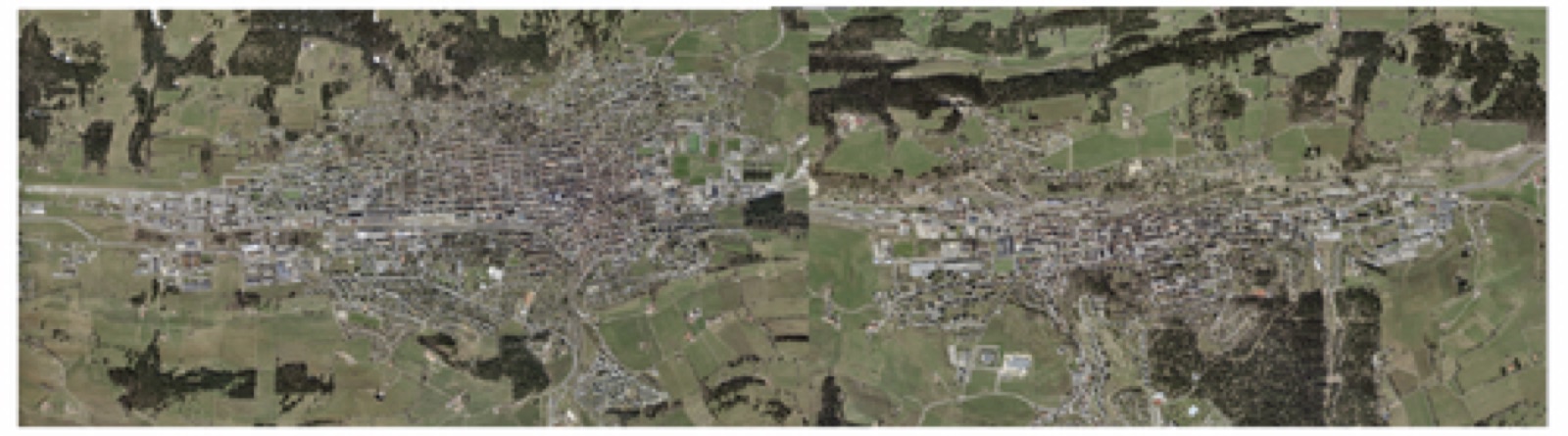
With the advent of the watchmaking production, even in the citizen’s life there was a shift between working with nature and technology, that probably resulted in a tension toward an idealized nature imaginary, strongly present in the art and iconography of the city (Fig. 3) But it’s an idealized notion of otherness, simplified and controlled. The wilderness is kept outside, with forests all around the city and is not felt the need to give quality to what is left inside. And the wild that stats inside happens by accident in leftover spaces.
The presence of nature within the city is very formalistic, shown as icons in shops, precisely cut trees and bushes. What stays within the city border are mostly representative and underqualified spaces, crossing points where is not worth staying or enjoying them. The squares are there but not really to be used and public green is kept to a minimum. Si les extérieurs sont sobres, les intérieurs sont plus soignés, plus riches. La mentalité du lieu fait qu’on vit socia- lement à l’intérieur, pas dans la rue. [If the exteriors are sober, the interiors are more polished, richer. The mentality of the place means that people live socially inside, not on the street.] (Dossier Unesco 2009, p 37)
People stay in their houses, that many had decorated with reassuring images of leaves and flowers (Fig 4).
The real interaction with nature happens outside, with several hike trails to enjoy this virtual pristine natural space as place for contemplation. Or in an informal way, reappropriating marginal spaces, unimportant pieces of land behind or in between the buildings, (Fig 5) where is allowed a more spontaneous and joyful interaction with it. The natural spaces presented on the front is quite minimalistic and controlled whereas these spaces are more unorderly, showing the active interference of the citizens.
And the cities’ structures themselves foster this diversification of nature. They were inspired by rigor and order, following the industrial principle even before its advent. Especially in La Chaux-de-Fonds there was the reorganization of the city, in the aftermath of the fire that destroyed most of it, imprinted on efficiency, a rigid grid that allows the city to be functional. “Linear expansion that followed the main axis of the valley and adhered to the existing natural slopes, reorganizing them through a sequence of parallel strips of building blocks, gardens and streets.” (De Pieri 2019)
Even the green space falls into the grid, drawing inspiration from plans like the one for Faust’s Sonnenstadt. (Fig 3). The whole city topography and the placement of its green spaces was driven by the industrial needs, to guarantee ideal illumination to the workshops and putting green in the more shaded sections (Fig 4)
“La topographie se montre favorable à de bonnes conditions d’exposition et la nécessité de lumière trouve une première réponse pragmatique par l’implantation des immeubles selon une orientation parallèle à l’axe des vallées sud-ouest / nord-est. Ainsi les constructions s’étagent sur les pentes douces, plus particulièrement sur l’adret, réduisant d’autant la portée de l’ombre. De plus, l’espace entre les massifs est calculé assez géné reusement en aménageant souvent des jardins au sud. Enfin, une morphologie de barre plutôt que d’îlot est généralisée évitant ainsi l’inconvénient de la mauvaise lumière du côté cour. Cela oblige cependant à régler la trame urbaine sur un maillage plus serré que l’habitude du XIXe siècle dans les nouveaux quartiers des villes occidentales.” (Dossier Unesco 2009, p12)
Even in the section is visible a succession of different degrees of green, that densifies going towards the forest. The closeness to the forest implies a change, an increase in tension towards nature and a lighter grasp of the production needs, linked to the mobility infrastructures present in more central locations.
Overall, there is almost a parallel between the precision of the clock industry and the controlled delimitation of the natural areas. However, the green spaces, even the ones that look untouched, are actually influenced by anthropic uses, especially the ones linked to agriculture or industry. And this link, even though often invisible, becomes visible as it has deeply influenced the contemporary fabric of the two cities, creating a more subtle storytelling than the one link to their industrial past: that the city is also shaped through the interaction or separation with nature.