February 23–25, 2023 Le Locle & La Chaux-de-Fonds, Switzerland — 47.0999° N, 6.7928° E EDAR Course AR-669

Index / PhD Notes / PHD–05

Corrado Scudellaro

Industrial Politics, Socio-cultural Landscape and the “Other” Narratives of the City

PHD–05 Politecnico di Torino Field Notes — Feb 2023

This report aims to analyse critically the urban exploration experience of La Chaux-de-Fonds and Le Locle, UNESCO heritage since 2009, and the methodology that was followed by the group of PhD students, but also individually, in developing a critical review of the urban landscape and the narratives of the city.

In particular, the main aim of the group was to understand how the narratives and the tendencies of the urban landscape, and thus its historical formation, shaped and modified the appearance of the city; at the same time, the spotlight that was identified through the UNESCO listing in 2009 is considered critically, to assess what was enlightened as “valuable” during the candidature and what was “omitted”, thus risking oblivion and lack of recognition in the future interventions in the city.

The report discusses the urban and architectural history of the two cities, the proposed methodology, and the outcomes and expectations that emerged in the discussant, supervisors, and citizens' meetings.

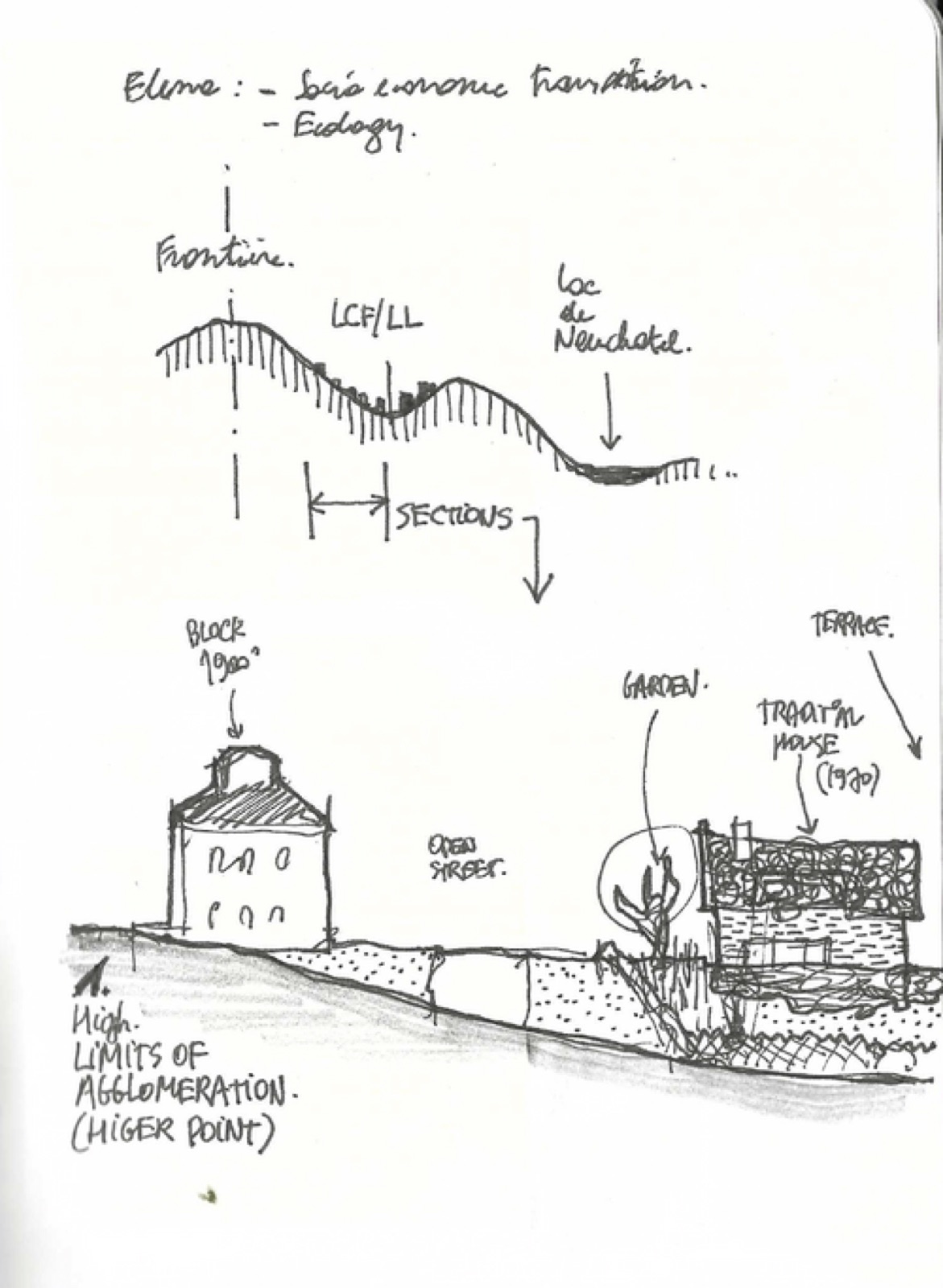
Field notes by Corrado Scudellaro, plate 1
Plate 01 — field notebook, Corrado Scudellaro
§ 02

La Chaux-de-Fonds and Le Locle: timeline and description

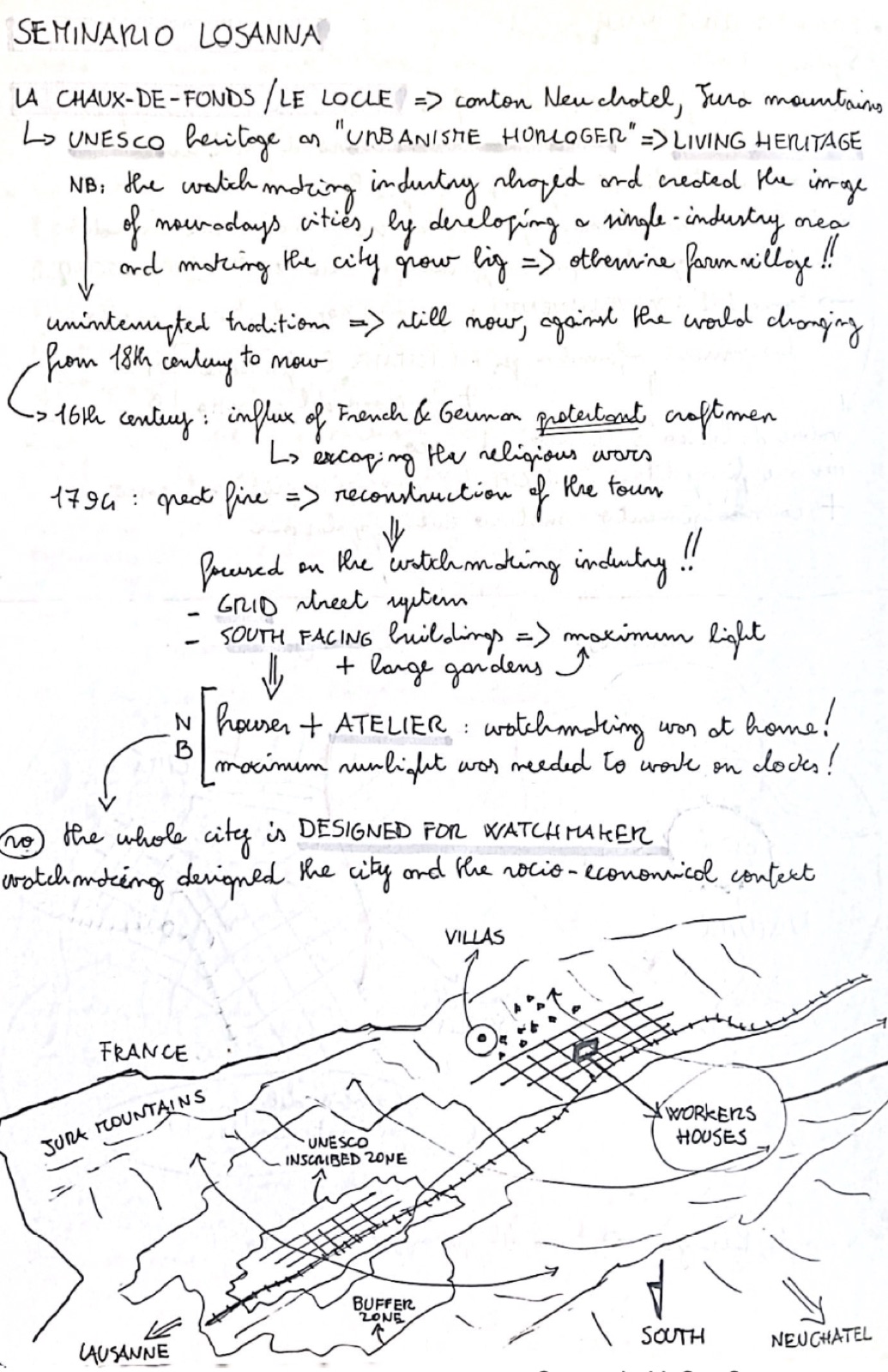
The watchmaking industry that emerged in the region at the end of the 18th century is responsible for La Chaux-de-Fonds' distinct character, appearance, and urban structure. By 1870, almost half of the town's total population of 4,500 people were directly employed in the watch industry. Without this investment in time measurement, La Chaux-de-Fonds would have likely remained an agricultural village.

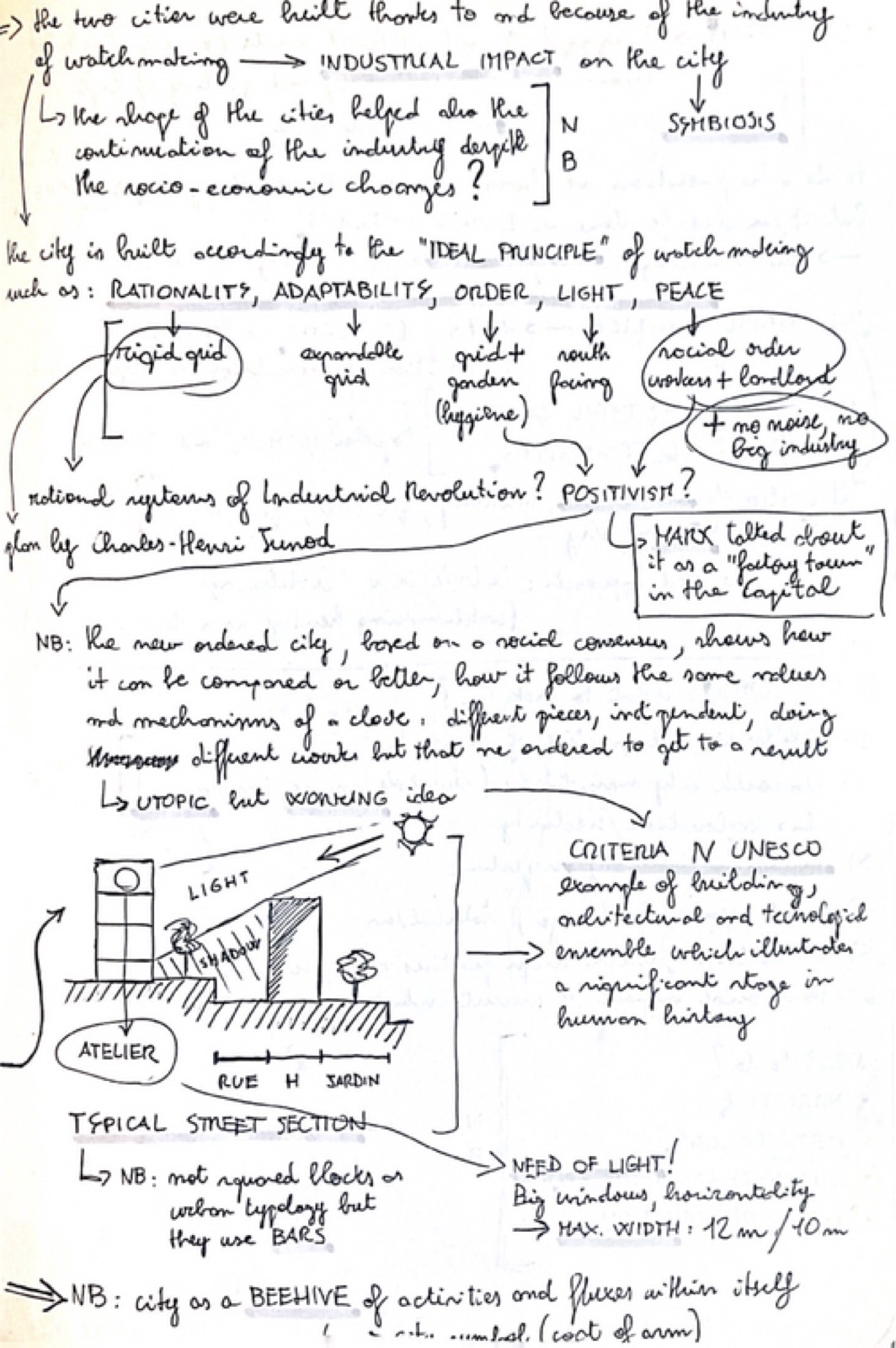
La Chaux-de-Fonds was designed and built with a checkerboard plan resulting from an idealistic urban planning approach applied after the 1794 fire that destroyed the entire village except for a few houses. Safety, health, and fairness were the guiding principles of the reconstruction plan, purely positivist, aiming to prevent fire spread, and provide open spaces, areas for vegetable gardens, and spaces for snow clearance.

Although La Chaux-de-Fonds was primarily known for clock-making in the late 18th century, the watch became the cornerstone of the town's prosperity in the 19th century. Today, La Chaux-de-Fonds is the third largest city in French-speaking Switzerland and the most complete and significant coherent urban ensemble of the 19th century in Switzerland.

On the other hand, the smaller Le Locle was historically considered the leading commune of the Neuchâtel Mountain region. It is recognized as the cradle of international watchmaking, with other industries such as machine tools, microtechnology, and medical equipment developing over the years, leveraging its acknowledged expertise.

The prodigious development of watchmaking began in the early 18th century. According to legend, Daniel JeanRichard, a young man from La Sagne, repaired a watch made in London, and subsequently produced another in his workshop in Le Locle, becoming the first artisan to master the complex technique of the pocket watch and founding the watch industry in the region. While some claim he invented the watch, it was already in existence at the time, albeit much rarer than the clock due to its high price.

Field notes by Corrado Scudellaro, section 02, plate 1
§ 02 · Plate 01 — Corrado Scudellaro
§ 03

As Filippo de Pieri has pointed out (De Pieri, 2019), the notion of watchmaking urbanism in La Chaux-de-Fonds is illustrated less in the configuration of the buildings themselves (typomorphologies, architectural style) than in the design of an urban structure resulting from disputed decisions between different actors, these decisions being notably inscribed in the successive versions of the Junod plan, which determined the urban morphology. The author challenges the concept of watchmaking urbanism on a scientific and historical level, mainly by the fact that it is difficult to establishing a clear link between the modes of production of the watchmaking industry itself and the various motivations expressed in the Junod Plan. He concludes, however, that the concept has potential in « pointing to space as a central object of inquiry », a point to which I will return later.

Albeit the historical fragility of the concept, it seems interesting to consider that the Junod plan was born, not from a conscious desire to adapt urban development to the watchmaking industry, but from a social and technical ecosystem deeply imbued with the operating and relational modes associated with this watchmaking industry. From this perspective, the need for a rationalization plan for urban development, for example, could be associated with the rapid development of the region due to its industrial activity. Similarly, the width of the town's streets, in addition to considerations related to fire protection, may also be correlated to the numerous journeys on foot that clerks made to distribute watches parts between workshops, as well as to the latter's need for light (Jeanneret, 2009, p.53).

Field notes by Corrado Scudellaro, section 03, plate 1
§ 03 · Plate 01 — Corrado Scudellaro
§ 04

Step 1 : round table and data comparison

Being the UNESCO narrative the one that dominates any information and source about the twin cities, the field investigation decided to follow it as a base for a working methodology, or better, as a paradigm of analysis of the urban landscape.

This focus was established and decided in the first step of the followed methodology: an initial round table between the Ph.D. students, based on their inclination, topics of interest, and background. Discussing the various research and the cultural, and intellectual backgrounds helped establish a base ground of narratives and bias that was necessary to consider in the next steps of urban exploration. The brainstorming meeting also helped focalise the different tools and documents at the students’ disposal for the analysis.

Step 2 : tools and narratives definition, recording of impressions.

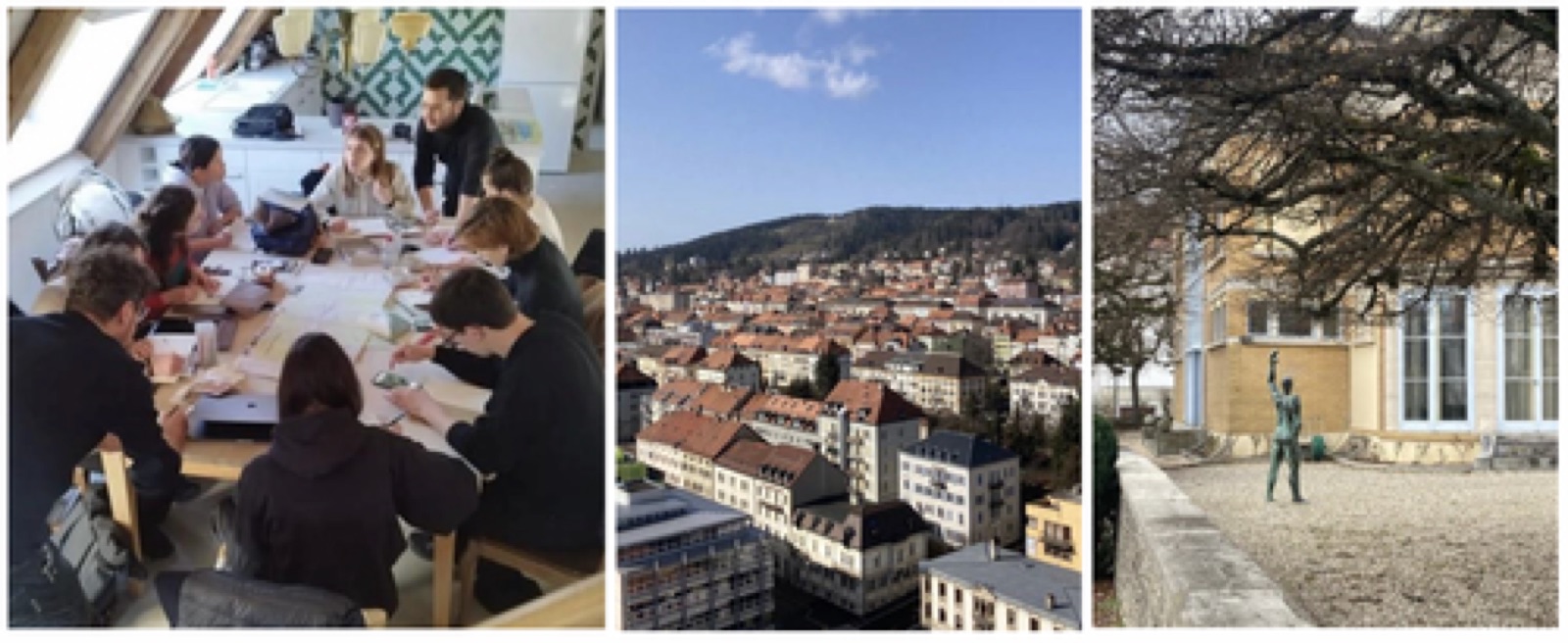
After careful consideration, the chosen employed tool was the tourist map of the two cities, clearly stressing the “watchmaking landscape” and proposing a touristic stroll around the city, to look at its manufactural landscape which was worthy of a World Heritage Listing. The tour of La Chaux-de-Fonds and Le Locle started at Tour Espacité belvedere, to grasp a bird-eye view of the city, with its planned grid as an impressive and almost monumental aspect of the panorama.

The followed methodology (from left to right): initial roundtable and definition of the exploration tools; bird-eye view and first-impressions analysis of the city; the “other narratives”: Le Corbusier’s Villa Turque

This visit and the subsequent stroll around the city produced different observations by the team: the urban landscape and the watchmaking heritage of the city were plotted and described on the tourist map, but it was not evident in the city tour. The aspect of the city that caught the immediate attention was clearly its impressive grid and organization, which spanned from one side to the other of the valley with few regards to topography. The plan was described in the UNESCO candidature as a double-value aspect: on one hand, the plan allowed a better organization of the city and thus a flourishing of economic activities and watchmaking manufacturing; on the other hand, the watchmaking industry itself shaped the city in giving it an organized and rigid structure, as a “mechanism” working precisely as a clock. From the city observation, instead, this aspect was not clear nor visible: the city seemed an impressive example of 19th-century urban planning, but the link

Field notes by Corrado Scudellaro, section 04, plate 1
§ 04 · Plate 01 — Corrado Scudellaro
§ 05

Step 3 : searching for “other narratives”

Thus, the third step of methodology, after researching the UNESCO narratives, was the scrutiny of the “other” narratives of the city, which are not stressed and not enlightened in the official documents. For example, La Chaux-de-Fonds is famous for its Art Nouveau architecture, which was indeed heavily influenced by the city's watchmaking industry; moreover, the city, as the birthplace of the Swiss architect Le Corbusier, presents a strong architectural legacy of early modernism: those aspects, even if identified in the tourist maps, are not stressed in the UNESCO listing, and thus they fall out of the spotlight of protection given by the World Heritage list.

From a socio-cultural point of view, a topic that is not described nor analysed by the “official” city narrative, La Chaux-de-Fonds has a strong socialist tradition and was an important centre of the Swiss socialist movement in the late 19th and early 20th centuries. The city was also home to the International Watchmen's Union, which played a significant role in the labour movement. The industriousness of the city made it an international attractor for the workforce: the two cities are culturally diverse, with a significant population of immigrants from Italy, Spain, and Portugal, which maintained several traditions, combining them with Swiss culture in a unique melting pot.

Narratives and spotlight: outcomes and considerations

The outcomes of the urban exploration and the followed methodology were discussed in a meeting with the other Ph.D. students, the supervisors, and the guest professor, which helped focus the target on the experience and the outcomes.

Agreeing or not with the reasons and explanations provided, it can be said that the UNESCO listing helped recognize the cities’ impressive industry and manufacturing savoir-faire. Moreover, the listing emphasised the effort and the endeavours of those small communities in rebuilding their cities with a new, organized, and positivist plan, an impressive grid system that still shapes the city and its expansions nowadays.

It is necessary, though, to admit that the UNESCO listing does put a spotlight on specific criteria and aspects of the city which, however symbolic they may be, do not describe the city in its entirety. In fact, by stressing only a single aspect of an urban landscape, in this case, the watchmaking industry and the “urbanisme horloger”, it is necessary to consider the risk of losing other parts of the city, thus denaturing the image, the genius loci of the settlement and the self-identification of the city with its citizen. It is a risk happening in cases in which a predominant narrative is hastily imposed on a territory.
Field notes by Corrado Scudellaro, section 05, plate 1
§ 05 · Plate 01 — Corrado Scudellaro
§ 06

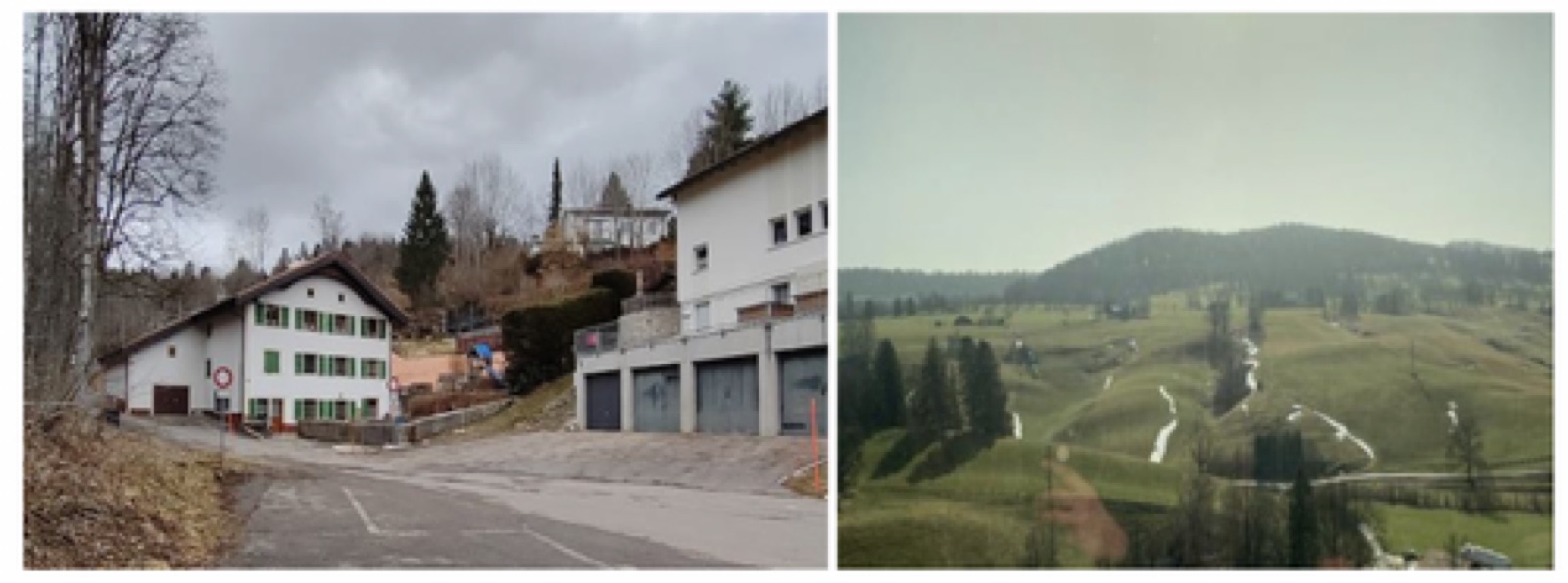
The ”other narratives” require a revaluation, to bring them back to light in a process of recognition and heritage-making. It is the case of working “around” the spotlight, in those fringe areas which are excluded, willingly or unwillingly, by the main narratives. The shadow areas that are omitted by the patrimonialisation process of the UNESCO listing are worthy of analysis and understanding, to avoid the risk of losing part of the heritage, be it material, such as the surrounding agricultural landscape, or immaterial, such as the vibrant folklore of the immigrants’ communities from Spain, Italy or Portugal.

Personal findings: new perspective in “minor heritage”

On a personal note, the seminar helped me determine a new perspective on my research topic. Working on heritage at risk, and especially focusing on those architectures which are usually considered “contextual” or “vernacular”, it was particularly interesting analysing how the perception of those heritages is often shaped and modified by the narratives of the city. For example, vernacular architecture is often considered a “minor heritage” because the main narratives on it describe it as “humble”, “poor” or “rural”, thus taking away from it the dignity of being considered a fundamental and constituent part of the image of the city, the cultural landscape and the social formation of a local population.

Finally, the seminar was particularly helpful in identifying what is the risk that heritage is subjected to, even in a privileged location such as Switzerland. The urban factors in heritage risk are clear in a city such as La Chaux-de-Fonds, because it shows how the urban expansion erases and sometimes ignores previous traces, such as the morphology of the terrain, the visible aspects of the landscape, and the pre-existing heritage.

The report, then, is displaying how even the modern and current tools for heritage protection, even at the highest level of World Heritage listing, are sometimes not adequate to interpret and understand the complex stratification of landscape heritage that a city embodies; it is a valuable lesson in understanding the limits and the future opportunities of intervention in the protected landscape, a perspective which will be included and analysed in deep in my future doctoral journey.

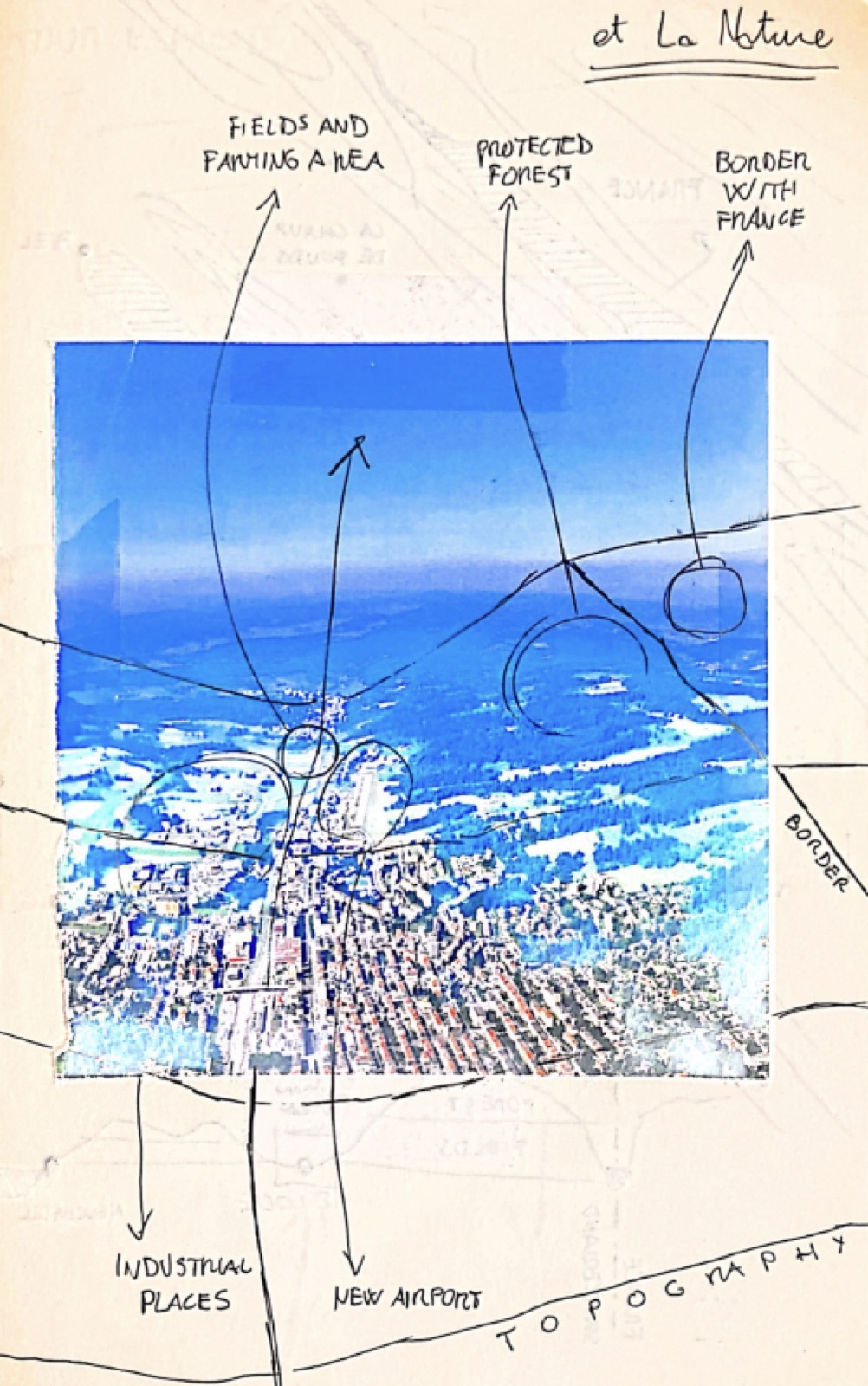
Field notes by Corrado Scudellaro, section 06, plate 1
§ 06 · Plate 01 — Corrado Scudellaro